
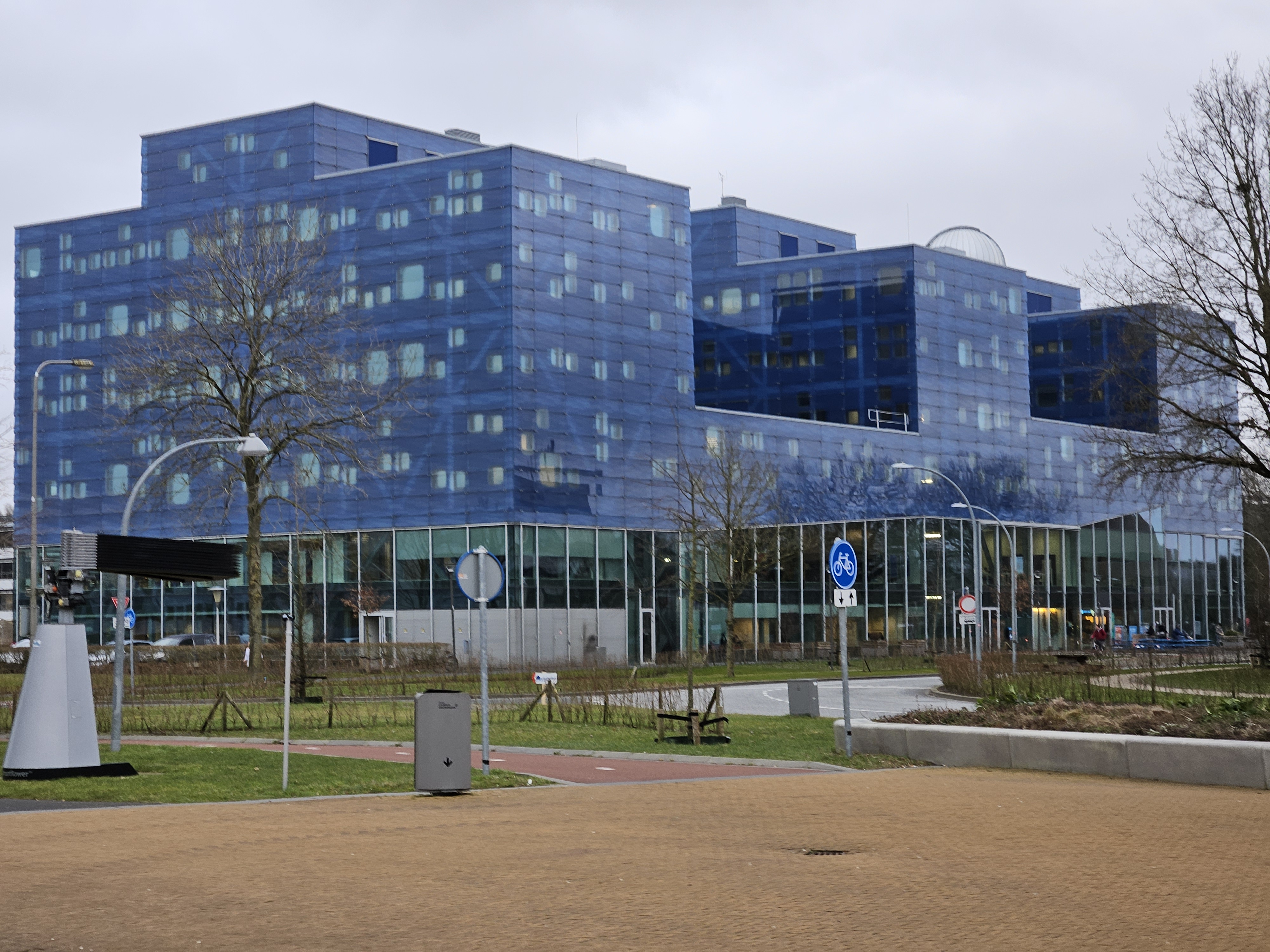
Visiting address
DS - BI
University of Groningen
Nijenborgh 9
9747 AG Groningen
The Netherlands
Quick links
Follow us
TODO
Student Colloquia
Centrality-Aware Learning vs Graph Neural Networks for State Estimation in Wastewater Systems
Supervisors:
Revin Naufal Alief,
Dilek Düştegör
Date: 2026-01-05
Type: bachelor-project/student-colloquium/master-internship/master-project
Description:
Reference: (Not exhaustive)
Centrality-Aware Machine Learning for Water Network Pressure Prediction.
A Systematic Review of Graph Neural Network Applications in Wastewater Systems
Supervisors:
Revin Naufal Alief,
Dilek Düştegör
Date: 2026-01-05
Type: bachelor-project/student-colloquium/master-internship/master-project
Description:
Graph Neural Network Empowers Intelligent Education: A Systematic Review From an Application Perspective. The PRISMA 2020 Statement: An Updated Guideline for Reporting Systematic Reviews. A Comprehensive Survey on Graph Neural Networks.
Uncertainty Quantification in GNN-based Water Level Estimation
Supervisors:
Revin Naufal Alief,
Dilek Düştegör
Date: 2026-01-05
Type: bachelor-project/student-colloquium/master-internship/master-project
Description:
References: Uncertainty Quantification over Graph with Conformalized Graph Neural Networks. Non-exchangeable Conformal Prediction for Temporal Graph Neural Networks.
Sparse Sensor Placement for Graph-Based State Estimation
Supervisors:
Revin Naufal Alief,
Dilek Düştegör
Date: 2026-01-05
Type: bachelor-project/student-colloquium/master-internship/master-project
Description:
Wastewater Systems Benchmark Dataset Development
Supervisors:
Revin Naufal Alief,
Dilek Düştegör
Date: 2026-01-05
Type: bachelor-project/student-colloquium/master-internship/master-project
Description:
Conditional planning an overview of approaches
Supervisors:
Heerko Groefsema
Date: 2025-02-05
Type: student-colloquium
Description:
Peot, M. A., & Smith, D. E. (1992, January). Conditional nonlinear planning. In Artificial Intelligence Planning Systems (pp. 189-197). Morgan Kaufmann. Blythe, J. (1999). An overview of planning under uncertainty. Artificial intelligence today, 85-110. Rintanen, J. (1999). Constructing conditional plans by a theorem-prover. Journal of Artificial Intelligence Research, 10, 323-352. Karlsson, L. (2001, January). Conditional progressive planning under uncertainty. In IJCAI (pp. 431-438).
Verifying the data perspective of business processes
Supervisors:
Heerko Groefsema
Date: 2025-02-05
Type: student-colloquium
Description:
Groefsema, H., Beest, N.R.T.P.v., Governatori, G. (2022). On the Use of the Conformance and Compliance Keywords During Verification of Business Processes. In: Business Process Management Forum. BPM 2022. Lecture Notes in Business Information Processing, vol 458. Springer. H. Groefsema, N.R.T.P. van Beest, A. Armas-Cervantes, Efficient conditional compliance checking of business process models, Computers in Industry, Volume 115, 2020. Alin Deutsch, Richard Hull, Fabio Patrizi, and Victor Vianu. 2009. Automatic verification of data-centric business processes. In Proceedings of the 12th International Conference on Database Theory (ICDT '09). N. van Beest, H. Groefsema, A. Cryer, G. Governatori, S. C. Tosatto and H. Burke, Cross-Instance Regulatory Compliance Checking of Business Process Event Logs, in IEEE Transactions on Software Engineering, vol. 49, no. 11, pp. 4917-4931, Nov. 2023.
Explaining Graph Neural Networks
Supervisors:
Andrés Tello
Date: 2025-02-01
Type: student-colloquium
Description:
Wang, X., & Shen, H. W. GNNBoundary: Towards Explaining Graph Neural Networks through the Lens of Decision Boundaries. In The Twelfth International Conference on Learning Representations. Müller, P., Faber, L., Martinkus, K., & Wattenhofer, R. (2024). GraphChef: Decision-Tree Recipes to Explain Graph Neural Networks. In The Twelfth International Conference on Learning Representations. Lu, S., Mills, K. G., He, J., Liu, B., & Niu, D. (2024). GOAt: Explaining graph neural networks via graph output attribution. arXiv preprint arXiv:2401.14578. Wang, X., & Shen, H. W. (2022). Gnninterpreter: A probabilistic generative model-level explanation for graph neural networks. arXiv preprint arXiv:2209.07924.
Generalization in Graph Neural Networks
Supervisors:
Andrés Tello
Date: 2025-02-01
Type: student-colloquium
Description:
Kanatsoulis, C., & Ribeiro, A. Counting Graph Substructures with Graph Neural Networks. In The Twelfth International Conference on Learning Representations. Liu, H., Feng, J., Kong, L., Liang, N., Tao, D., Chen, Y., & Zhang, M. (2023). One for all: Towards training one graph model for all classification tasks. arXiv preprint arXiv:2310.00149. Lee, H., Yoon, K., 2023. Towards better generalization with flexible representation of multi-module graph neural networks. Transactions on Machine Learning Research. Yu, J., Liang, J., & He, R. (2023). Mind the Label Shift of Augmentation-based Graph OOD Generalization. In Proceedings of the IEEE/CVF Conference on Computer Vision and Pattern Recognition (pp. 11620-11630).
Multimodality Graph Foundation Models
Supervisors:
Huy Truong
Date: 2025-01-21
Type: student-colloquium
Description:
Lam, Hoang Thanh, et al. "Otter-Knowledge: benchmarks of multimodal knowledge graph representation learning from different sources for drug discovery." *arXiv preprint arXiv:2306.12802* (2023). Xia, Lianghao, Ben Kao, and Chao Huang. "Opengraph: Towards open graph foundation models." *arXiv preprint arXiv:2403.01121* (2024). Ektefaie, Yasha, et al. "Multimodal learning with graphs." *Nature Machine Intelligence* 5.4 (2023): 340-350.
Test-Time Training
Supervisors:
Huy Truong
Date: 2025-01-21
Type: student-colloquium
Description:
Sun, Yu, et al. "Test-time training with self-supervision for generalization under distribution shifts." International conference on machine learning. PMLR, 2020. Liu, Yuejiang, et al. "Ttt++: When does self-supervised test-time training fail or thrive?." Advances in Neural Information Processing Systems 34 (2021): 21808-21820. Liang, Jian, Ran He, and Tieniu Tan. "A comprehensive survey on test-time adaptation under distribution shifts." *International Journal of Computer Vision* (2024): 1-34. Behrouz, Ali, Peilin Zhong, and Vahab Mirrokni. "Titans: Learning to Memorize at Test Time." arXiv preprint arXiv:2501.00663 (2024).
Cluster Scheduling for DLT workloads
Supervisors:
Kawsar Haghshenas,
Mahmoud Alasmar
Date: 2025-01-27
Type: student-colloquium
Description:
Wencong Xiao, Romil Bhardwaj, Ramachandran Ramjee, Muthian Sivathanu, Nipun Kwatra, Zhenhua Han, Pratyush Patel et al. "Gandiva: Introspective Cluster Scheduling for Deep Learning." In 13th USENIX Symposium on Operating Systems Design and Implementation (OSDI 18), pp. 595-610. 2018. Weng, Q., Yang, L., Yu, Y., Wang, W., Tang, X., Yang, G., & Zhang, L. (2023). Beware of Fragmentation: Scheduling {GPU-Sharing} Workloads with Fragmentation Gradient Descent. In 2023 USENIX Annual Technical Conference (USENIX ATC 23) (pp. 995-1008). Zhang, X., Zhao, H., Xiao, W., Jia, X., Xu, F., Li, Y., ... & Liu, F. (2024). Rubick: Exploiting Job Reconfigurability for Deep Learning Cluster Scheduling. arXiv preprint arXiv:2408.08586. Lai, F., Dai, Y., Madhyastha, H. V., & Chowdhury, M. (2023). {ModelKeeper}: Accelerating {DNN} training via automated training warmup. In 20th USENIX Symposium on Networked Systems Design and Implementation (NSDI 23) (pp. 769-785).
Estimating Deep Learning GPU Memory Consumption
Supervisors:
Kawsar Haghshenas,
Mahmoud Alasmar
Date: 2023-12-11
Type: student-colloquium
Description:
Yanjie Gao, Yu Liu, Hongyu Zhang, Zhengxian Li, Yonghao Zhu, Haoxiang Lin, and Mao Yang. "Estimating GPU memory consumption of deep learning models." In Proceedings of the 28th ACM Joint Meeting on European Software Engineering Conference and Symposium on the Foundations of Software Engineering, pp. 1342-1352. 2020. Haiyi Liu, Shaoying Liu, Chenglong Wen, and W. Eric Wong. "TBEM: Testing-Based GPU-Memory Consumption Estimation for Deep Learning." IEEE Access, 10, pp.39674-39680. 2022. Lu Bai, Weixing Ji, Qinyuan Li, Xilai Yao, Wei Xin, and Wanyi Zhu. "Dnnabacus: Toward accurate computational cost prediction for deep neural netw." arXiv preprint arXiv:2205.12095. 2022. Yanjie Gao, Xianyu Gu, Hongyu Zhang, Haoxiang Lin, and Mao Yang. "Runtime performance prediction for deep learning models with graph neural network." In IEEE/ACM 45th International Conference on Software Engineering: Software Engineering in Practice (ICSE-SEIP), pp. 368-380. 2023.